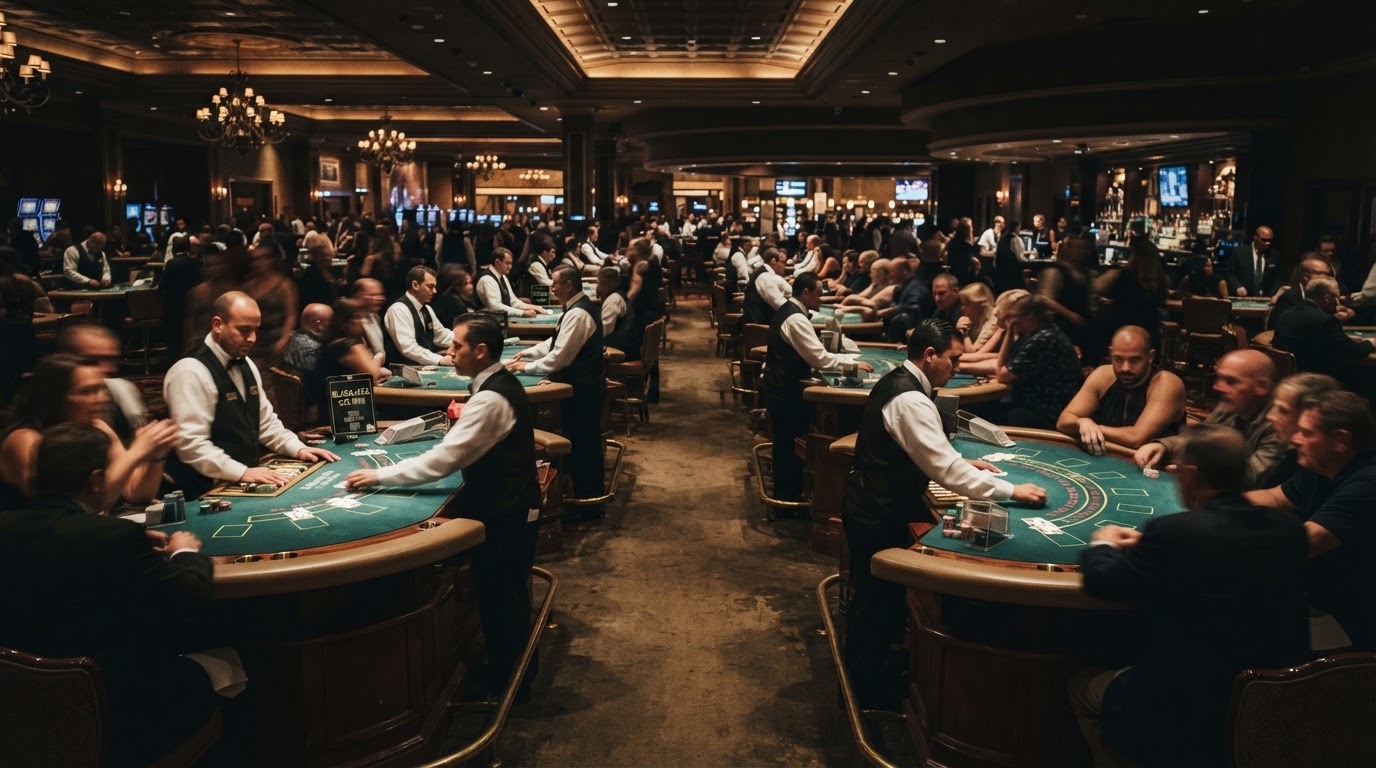
The Game · The Rules · The House Edge
Check The Felt
Before You Buy In.
A blackjack that pays 6:5 costs you about 1.4% of house edge — before you play a single hand
Most players choose a table by the minimum bet and the empty seat. The two things that actually decide what the game costs you are printed on the felt and written on the dealer's shoe: what a natural pays, and whether the dealer hits soft 17. Get those two right and you are playing one of the best games on the floor. Get them wrong and you are playing something four times more expensive that looks identical from six feet away. This guide explains what to look for, what each rule is worth, and how to check before you sit down.
Part of the Vantage Corridor Casino Network
3:2 Or Walk
The payout change that cost players more than every bad hit decision combined
A blackjack natural — an Ace with any ten-value card on the first two cards — is the best hand in the game. For most of the game's history a natural paid 3:2. A $25 bet won $37.50.
Beginning in the 2000s and accelerating through the 2010s, casinos began paying 6:5 on naturals instead. That same $25 bet now wins $30. The seven-dollar-fifty difference looks small. It is not: naturals turn up on roughly 4.7% of hands in a six-deck game, about one hand in twenty-one, and the change adds about 1.4 percentage points to the house edge — 1.36% at six decks, 1.39% at single deck, where naturals come slightly more often.
Put that against the game it replaced. A six-deck shoe where the dealer stands on soft 17, with double-after-split allowed, runs a house edge near 0.46% against a basic-strategy player once the cut-card effect in a real dealt shoe is counted. Change nothing except the payout and add a dealer who hits soft 17, and you are at roughly 2%. Four times the cost, same table, same felt colour, same dealer.
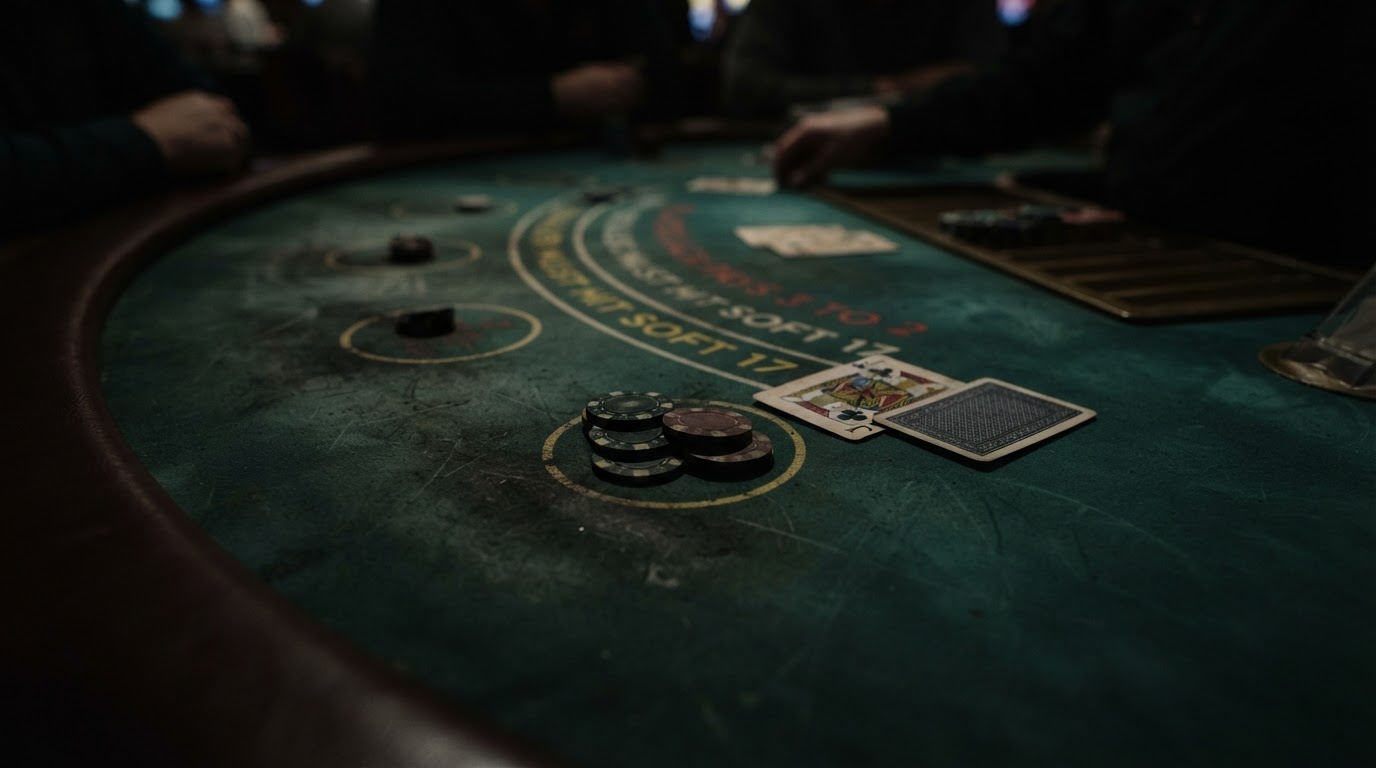
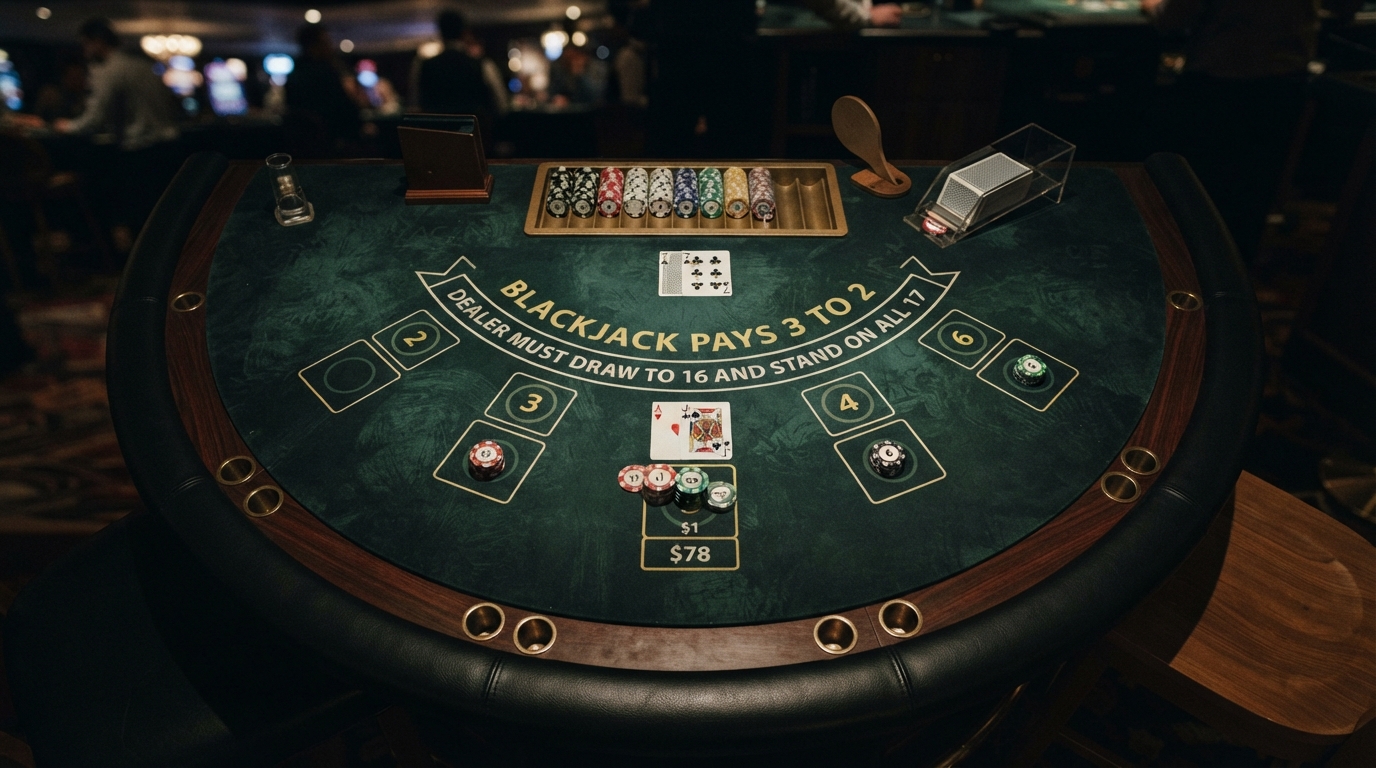
The tell is printed on the layout. BLACKJACK PAYS 3 TO 2 is the game you want. BLACKJACK PAYS 6 TO 5 is the one to walk past. Some rooms run both on the same floor, usually with 6:5 at the lower minimums — which means the cheapest-looking table is frequently the most expensive one in the room.
The one-sentence version. If the felt says 6:5, the table costs you roughly four times what the 3:2 table twenty feet away costs you, and no amount of correct play closes that gap.
What The Difference Actually Costs
Same stake, same strategy, two different games
3:2 GAME
Six-Deck Shoe · S17 · DAS · Basic Strategy
- House edge
- ~0.46%
- A natural on $25 pays
- $37.50
- Expected cost, 100 hands at $25
- ~$11.50
About as good as the game gets for a recreational player.
6:5 GAME
Six-Deck Shoe · H17 · Basic Strategy
- House edge
- ~2.0%
- A natural on $25 pays
- $30.00
- Expected cost, 100 hands at $25
- ~$49.50
Roughly four times the cost of the table across the aisle.
Expected cost is house edge multiplied by the total of your initial bets — that is how house edge is defined. Doubles and splits put more money in action than that; measured against everything you actually wager, the same game's cost per dollar risked is a little lower, around 0.38% for a standard 3:2 shoe. Either way the comparison between the two columns holds.
How long 100 hands takes depends on the table. A full table of six or seven players deals roughly 60 to 70 hands an hour. Four or five players is more like 80 to 95. Heads-up against the dealer runs 150 to 200 and up, which is why an empty table is not the bargain it looks like on a bad game — you reach the house edge faster. Continuous shuffling machines add roughly another 20%.
Figures are from published combinatorial analysis for the stated rule sets. Real results vary; nothing here predicts a session.
The Four Rules That Move The Number
After the payout, these are what separate a good table from an expensive one
Payout is the big one. These four are the rest of the gap, and unlike the payout they are rarely posted — you ask the dealer or you watch a few hands. The percentages below are for a six-deck game; each is the change in house edge, so a plus sign is money out of your pocket.
DEALER HITS SOFT 17 (H17)
+0.20% to +0.22% — the one that matters
A soft 17 is an Ace plus a six — 17 that cannot bust on one card. Where the dealer must stand on it (S17), the house edge in a six-deck DAS game is about 0.40%. Where the dealer hits it (H17), the same game runs about 0.62%. It is the largest rule difference on the floor after the payout, and it is usually printed on the layout in small type. S17 is the table you want.
DOUBLE AFTER SPLIT (DAS)
−0.14% — take it where you find it
Lets you double down on a hand created by splitting a pair. Standard in most modern shoe games and worth about 0.14% in your favour, which makes its absence a quiet red flag: a game that withholds DAS is usually withholding other things too. Some single-deck games restrict it.
RESPLIT ACES (RSA)
−0.08% — rare, and a good sign
Most rooms deal one card to each split Ace and that is the end of it. Where you are allowed to split Aces again after drawing another Ace, the game gives back about 0.08%. Small on its own. Worth noticing because rooms that allow it tend to run player-friendly rules across the board.
LATE SURRENDER
−0.07% to −0.08% — only if you use it correctly
Lets you give up half your bet and fold after the dealer checks for blackjack. Worth roughly 0.07% in a six-deck S17 game and a little more where the dealer hits soft 17 — but only to a player who surrenders the right hands and no others. Surrendering because a hand feels bad costs more than the rule returns. Increasingly rare; most common in high-limit rooms.
Stack the good versions and a six-deck game gets to roughly 0.35%. Stack the bad ones onto a 6:5 payout and the same-looking table is near 2%. This is the whole spread, and none of it is hidden — it is just not advertised.
How To Read A Table In Thirty Seconds
Five checks, standing behind the seats, before you buy in
We do not publish a live rule-by-rule table for every casino in America, and neither does anyone else honestly — payouts change without notice, and a single room routinely runs 3:2 at $50 and 6:5 at $15 on the same floor on the same night. What travels is the method. Do these five checks from behind the seats and you will know what the game costs before you have bought a chip.
Read the payout off the layout.
BLACKJACK PAYS 3 TO 2 is the game. 6 TO 5 is not. It is printed on the felt in front of the dealer, in small type, on every table. If you read nothing else, read this.
Find the soft-17 rule.
Also on the layout: DEALER MUST STAND ON ALL 17s or DEALER MUST HIT SOFT 17. Stand is worth about 0.22% to you. If the felt does not say, ask the dealer — they will tell you, and they will not mind.
Count the decks.
Look at the shoe. Six and eight decks are the common shoe games. A hand-dealt single or double deck game is worth checking closely, because most surviving single-deck games pay 6:5 — which makes them worse than the six-deck shoe next to them, not better.
Ask about double after split.
One question to the dealer. Allowed is worth about 0.14%. Not allowed usually means the rest of the rule set is tight too.
Watch two hands before you sit.
You will see the shuffle, whether it is a continuous shuffler, how fast the dealer is dealing, and whether the table is full. All three change how many hands an hour you play, which is what turns a house edge into an actual number.
Where the room-by-room detail lives. Rule sets are reported by players who were at the table this week, not by editors who visited last year. That reporting happens in The Pit — the network's player community — where members rate table conditions and flag payout changes as they happen. If you want to know what a specific room is running right now, that is where to ask.
Rooms Worth Checking
Table-games floors across the network known for depth of live blackjack
These are rooms with real live-dealer blackjack floors — enough tables, enough limit levels, and enough of a table-games reputation to be worth a detour. This is a list of rooms, not a list of rule sets. Verify the payout and the soft-17 rule at the table you actually sit at, every visit.
MIDWEST HEARTLAND
Mystic Lake Casino Hotel
Prior Lake, MN. Shakopee Mdewakanton Sioux Community. Live dealer blackjack under a Class III tribal-state compact, plus baccarat, Three Card Poker and Mississippi Stud. Minnesota's compacts permit card games but not roulette or craps, so the "roulette" here is an electronic substitute — the blackjack is not.
Ameristar Casino Hotel Council Bluffs
Council Bluffs, IA. Operated by Penn Entertainment. The last riverboat casino in Council Bluffs; Penn received Iowa Racing and Gaming Commission approval in April 2025 to replace it with a new land-based Hollywood Casino Council Bluffs, so expect the property to change over the next few years.
Prairie Meadows
Altoona, IA. Owned by Polk County, leased to the nonprofit Racing Association of Central Iowa. Live blackjack in several variants alongside craps, roulette and pai gow.
WarHorse Casino Lincoln
Lincoln, NE. WarHorse Gaming, a commercial licensee under the Nebraska Racetrack Gaming Act. Live table games including blackjack arrived in November 2024; a further expansion runs into 2027.
GREAT LAKES CORRIDOR
Rivers Casino Des Plaines
Des Plaines, IL. Rush Street Gaming. One of the deepest table-games floors in the Chicago market.
FireKeepers Casino Hotel
Battle Creek, MI. Nottawaseppi Huron Band of the Potawatomi. Over sixty live table games.
Four Winds South Bend
South Bend, IN. Pokagon Band of Potawatomi. Live Class III table games since August 2021 — twenty-seven of them, running around the clock. Older guides still describe this property as electronic-only; that has not been true for years.
Potawatomi Casino Hotel
Milwaukee, WI. Forest County Potawatomi Community. Renamed from Potawatomi Hotel & Casino. Live blackjack including a promoted low-minimum game on weekday mornings.
GULF OF AMERICA COAST
Beau Rivage Resort & Casino
Biloxi, MS. MGM Resorts International. A dedicated high-limit salon with roughly ten blackjack tables and its own cashier — the deepest high-limit blackjack on the coast.
IP Casino Resort Spa
Biloxi, MS. Boyd Gaming.
Caesars New Orleans
New Orleans, LA. Renamed from Harrah's New Orleans in May 2024; Caesars marked the completion of a $435 million transformation in October 2024. A block from the river and walkable to the French Quarter.
L'Auberge Lake Charles
Lake Charles, LA. Penn Entertainment. The Houston market's nearest full resort floor, roughly two hours east on I-10.
BLACK HILLS / DEADWOOD
The Deadwood gaming district
Deadwood, SD. Around twenty commercial casinos in a few walkable blocks, with a $1,000 maximum bet in force since July 2012. Not every property runs table games — all have slots and video poker, and blackjack, craps and roulette are spread across a subset — so the district rewards walking before sitting.
Cadillac Jack's Gaming Resort
Deadwood, SD. Live blackjack, craps, roulette and poker alongside 240-plus slots.
Tin Lizzie Gaming Resort
Deadwood, SD. The former Four Aces property and its adjoining Hampton Inn have been consolidated into Tin Lizzie; Four Aces no longer operates under its own name. Older listings still show it separately.
Caesars Resort Deals
Current room rates across the Caesars Rewards portfolio
Several of the rooms above sit inside the Caesars portfolio, and Caesars Rewards is the loyalty programme most likely to be worth carrying if your blackjack lives in the Midwest and along the Gulf. Current rates and packages are on their booking site.
BestInBlackjack.Casino may earn a commission on bookings made through this link. It costs you nothing and does not affect what we write. We do not accept payment for placement, rankings, or coverage.
Where To Go Deeper
Property-level detail lives on the state and city guides
This site covers the game. The guides below cover the floors — every property, drive times, limits, and what each market is actually like.
Blackjack Intel
Four things worth knowing before your next session
STRATEGY
Basic Strategy Is Free, And You Are Allowed To Use It At The Table
A basic strategy chart is the mathematically correct play for every hand against every dealer upcard. It is free, it is a solved problem, and casinos will let you put the card on the felt and read it — the house edge already assumes some players use it. Playing correctly gets a six-deck S17 game down to roughly 0.40%. Playing on instinct typically costs another one to two percentage points, which is more than the difference between 3:2 and 6:5. The chart is the cheapest edge in the building and most players at the table are not using it.
TABLE RULES
Single Deck Is Almost Never The Better Game Anymore
Fewer decks genuinely favours the player — a single-deck game is worth roughly half a percent over an eight-deck shoe on deck composition alone. That advantage was real, and it is why single deck had a reputation. It is also why casinos changed the payout: a 2026 survey of the Las Vegas market found no 3:2 single-deck games left in the city at all. A single-deck 6:5 H17 game runs about 1.44%. The six-deck 3:2 S17 shoe beside it runs about 0.40%. The deck count is a smaller effect than the payout, every time, and the hand-dealt game that feels more authentic is usually the more expensive one.
HOUSE EDGE
H17 Versus S17 — The Rule Nobody Reads
Everyone checks the minimum. Almost nobody checks whether the dealer hits soft 17. In a six-deck DAS game the difference is 0.40% against 0.62% — the dealer hitting soft 17 costs you roughly 0.22 percentage points, which over a few hours at a moderate stake is real money, and it is the second-largest rule effect on the floor after the payout. It is printed on the layout. It takes two seconds. On a floor running both, the S17 tables are often at a higher minimum, which is a trade worth doing more often than players think.
SESSION MATH
An Empty Table Is Not The Bargain It Looks Like
House edge is a rate, not a bill. What turns it into money is how many hands you play. A full table of six or seven deals roughly 60 to 70 hands an hour; four or five players is 80 to 95; heads-up against the dealer is 150 to 200 and up. Sitting alone at a good game is fine. Sitting alone at a bad one means you reach the house edge three times faster. If the only open seat is at a 6:5 table with nobody else at it, that is the most expensive seat in the room.
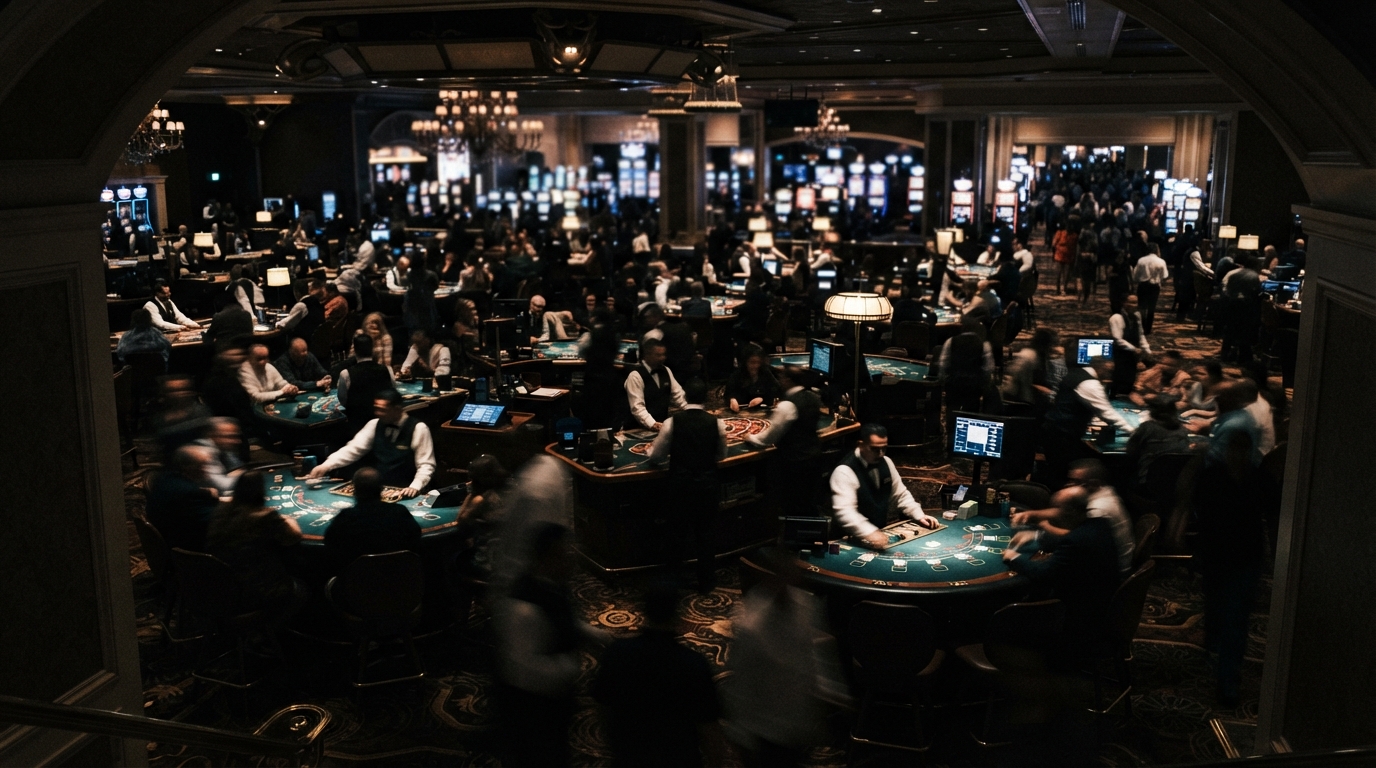
Table Conditions, Reported By People Who Were There
The Pit — the Vantage Corridor player community
Rule sets change quietly. A room switches its low-limit tables to 6:5 on a Thursday and no press release goes out — the only people who know are the players who sat down that weekend. The Pit is where that gets reported: members rate table conditions, flag payout and rule changes as they find them, log sessions, and collect passport stamps at properties across the network.
- Rate table conditions at properties you actually played
- Flag payout and rule changes as they happen, before the guides catch up
- Compare notes on comps and table-games host treatment
- Ask what a specific room is running this week, and get an answer from someone who was there
Blackjack Intel In Your Inbox
Rule change reports, payout alerts, and road trip picks. Monthly.
No spam. Unsubscribe anytime. Part of the Vantage Corridor Casino Network.
PAYOUT ALERTS
when a property in the network changes what a natural pays
RULE CHANGE REPORTS
soft-17 and double-after-split changes as members find them
ROAD TRIP PICKS
table-games floors worth the drive, monthly
Play Responsibly
Blackjack rewards correct play more than most casino games, and correct play still loses money over time — every rule set on this page carries a house edge, and none of them can be beaten by playing well. Decide what a session costs you before you sit down, and treat that number as the price of the evening. If gambling stops being entertainment, help is available 24 hours a day.
National Problem Gambling Helpline: 1-800-522-4700
National Council on Problem Gambling: https://ncpgambling.org
BestInBlackjack.Casino is an independent guide to casino blackjack. We do not operate gambling facilities and we are not affiliated with any casino or operator. Table conditions change without notice — always verify the payout and dealer rules at the table before you play. Must be 21+ to gamble.